Give Us a Call!
(612) 998-9500
Give Us a Call!
(612) 998-9500 

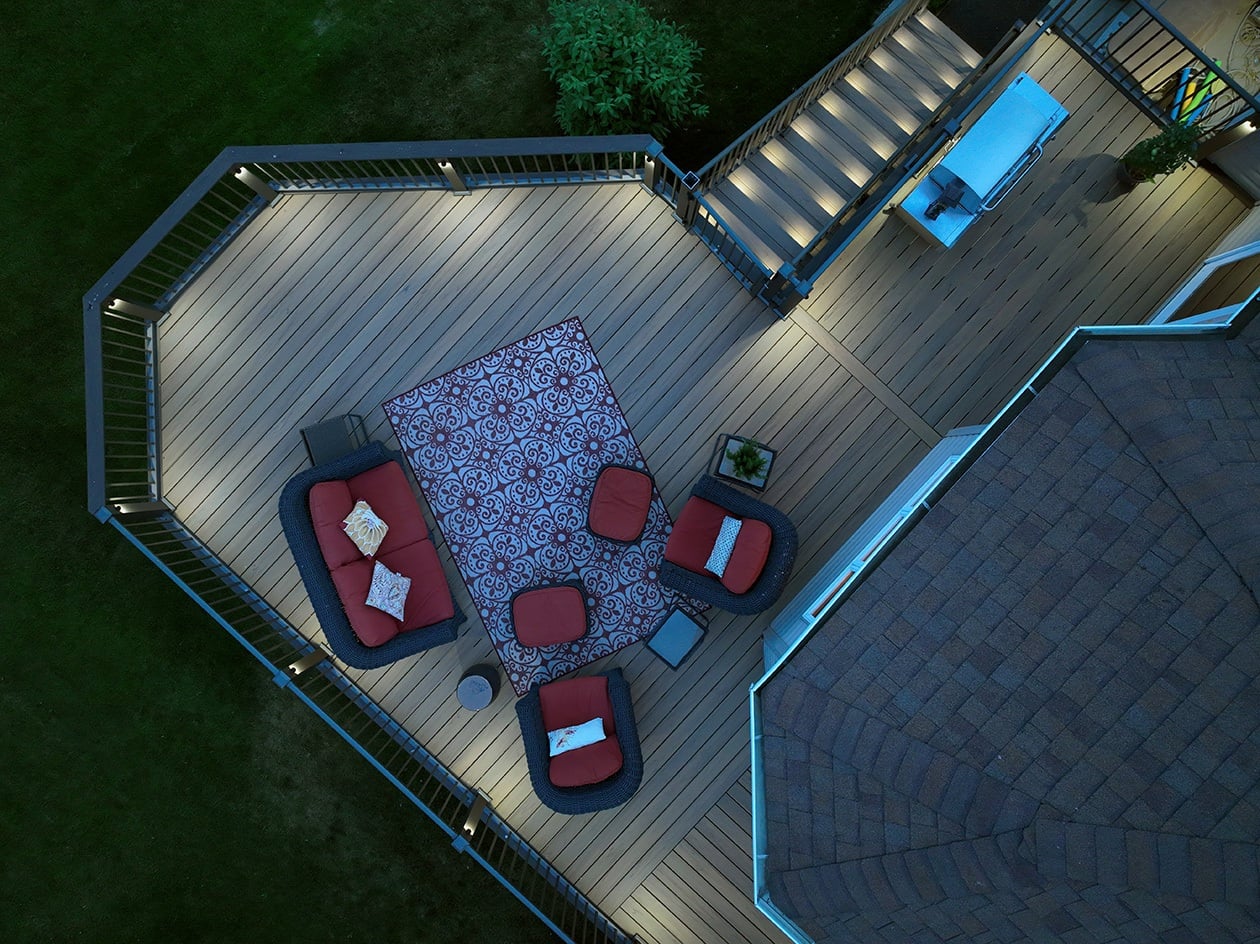


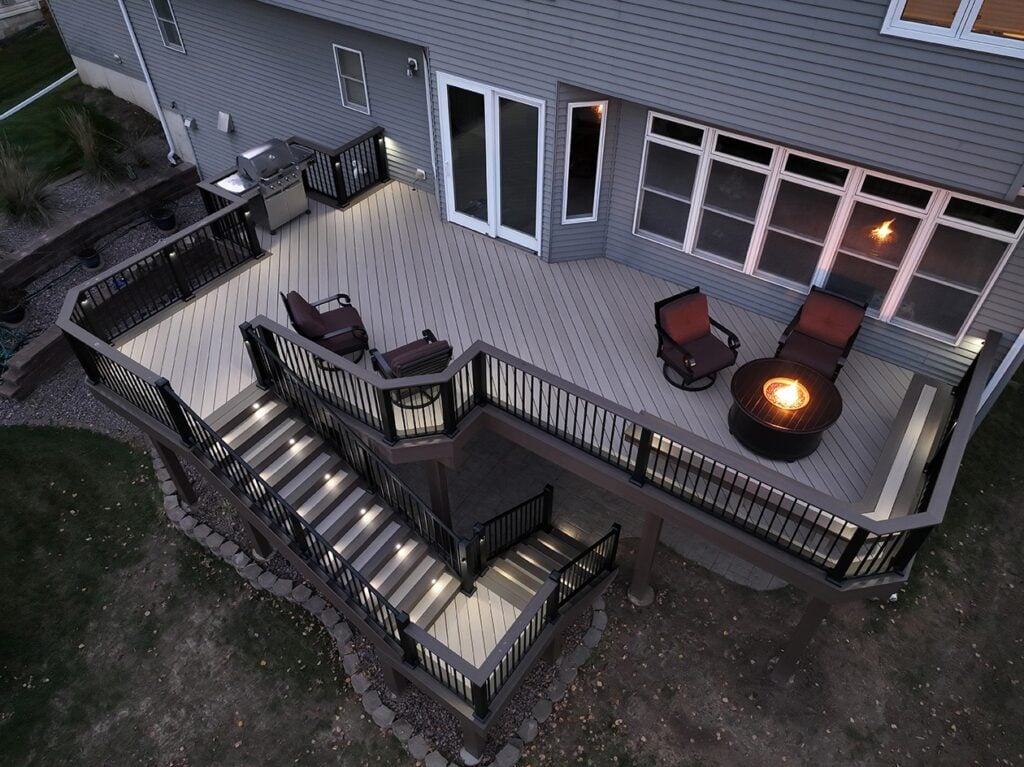
Integrated deck lighting is one of the best ways to extend evenings on your deck well after sundown. The right system makes stairs safer, defines your railing perimeter, and turns a good-looking deck into a finished outdoor room that works long after the sun drops. This guide covers the most effective lighting options across Trex, TimberTech, Westbury, and Kadenz — and how to match them to your deck.
In This Article:
- Why Minnesota Decks Need Good Lighting
- The 5 Main Types of Deck Lighting
- Trex Deck Lighting
- TimberTech Deck Lighting
- Westbury Railing + Magena Star Lighting
- Kadenz Railing Lighting
- Solar vs. Low-Voltage: What to Know
- How Voyager Helps You Design a Lighting Plan
- Deciding if Integrated Deck Lighting Is Right for Your Home
Looking for more upgrades for your deck? Start with Voyager’s guide to deck upgrades.
Why Minnesota Decks Need Good Deck Lighting
A deck in Minnesota has to work hard for a short season. Evenings cool fast. The sun sets early by September. That’s lost time you can reclaim with integrated deck lighting.
A great lighting system keeps your space functional and comfortable after dark, extends the hours you actually use the deck, and elevates the aesthetic beauty of your deck after dusk.
The practical case for lighting is strong:
- Safety — Stair lights, riser lights, and post lighting make steps, edges, and walking paths visible after dark.
- Usability — A well-lit deck supports grilling, entertaining, and relaxing well into the evening.
- Design — Lighting highlights posts, rails, and transitions instead of letting them disappear at night.
- Curb appeal — A lit deck looks finished from the yard, patio, or lake side of the home.
The right choice comes down to three things: the materials your deck is built with, the brand or collection you’re working within, and how you actually want to use the space. So let’s dive into the types of lighting first — then we’ll walk through the brands available in the Twin Cities.

The 5 Types of Deck Lighting
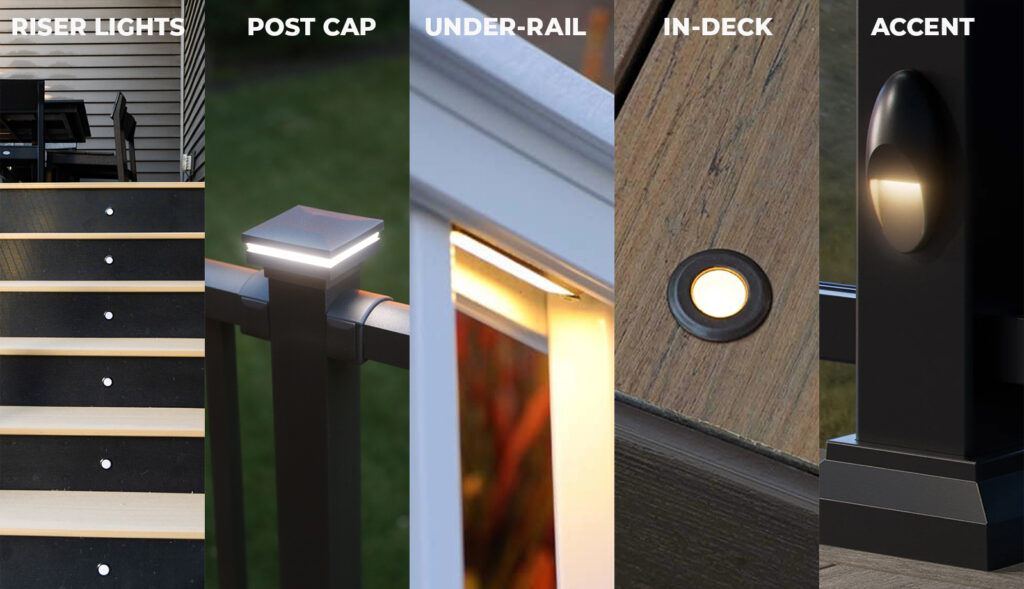
Before comparing brands, it helps to understand what’s available. Most integrated deck lighting falls into five categories.
1. Stair and Riser Lights
Stair lighting is typically the first place to start. Riser lights install into the stair face and cast light across each step — subtle, practical, and high-impact. If you have multiple stair runs, a landing, or a transition to a patio or yard, stair lighting is the most functional upgrade you can make.
2. Post Cap Lights
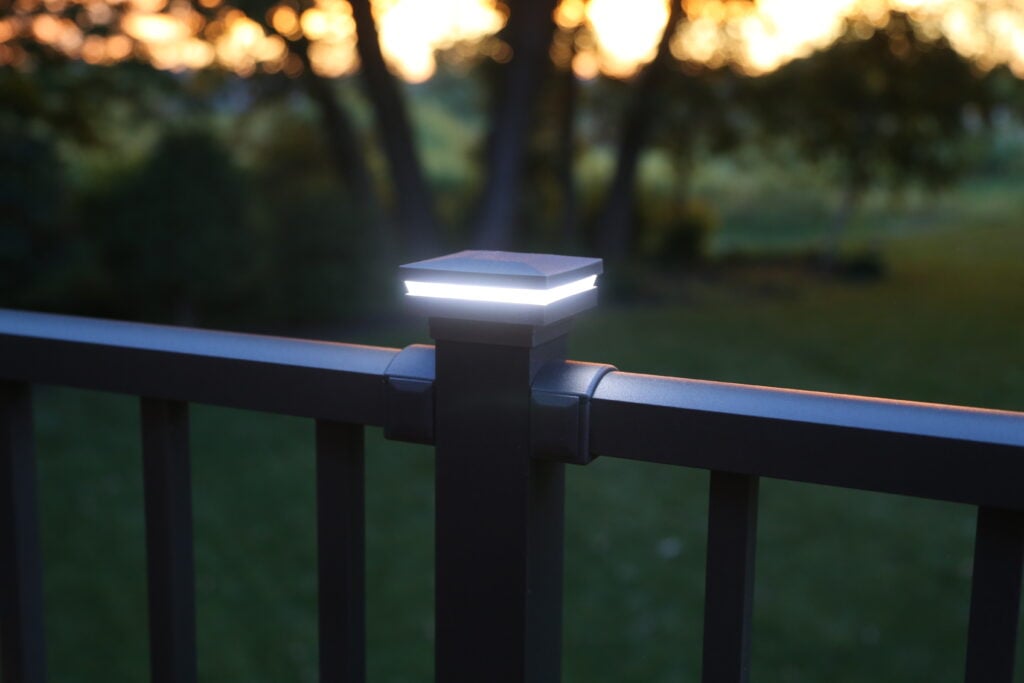
Post cap lights sit at the top of your railing posts. They add a soft glow, define the deck perimeter, and give the railing a finished look after dark. On a larger deck, repeated post caps create a clean visual rhythm around the entire outdoor room.
3. Under-Rail Lights
Under-rail lighting installs beneath the railing and washes light downward onto the deck surface. It’s one of the best options for ambient evening light — the fixture stays hidden, the effect is subtle, and the deck feels warmer and more inviting.
4. In-Deck Lights
In-deck lights install directly into the deck boards or frame. They’re used to outline traffic paths, define zones, or add low-profile perimeter lighting. These work best when planned early — fixture placement and wiring need to be part of the original deck build.
5. Accent Lights
Accent lights are smaller fixtures used to highlight specific details — corners, posts, transitions, or architectural features. They’re most useful when layered into a broader lighting plan rather than used on their own.
Trex Deck Lighting Options
Trex offers a full integrated outdoor lighting line designed to coordinate with its decking and railing systems. If your deck is already built with Trex materials, it’s worth knowing that Trex offers its own lighting solutions designed specifically for their product lines — keeping everything cohesive from the boards up.
What Trex offers:
- Stair Riser Lights — One of the most practical options for any deck with stairs. Installs into the riser and casts light across each step. A strong first choice for walkout decks and homes where safety is a priority.
- Post Cap Lights — Adds light from the top of the post, outlines the deck perimeter, and gives the railing system a finished presence after dark.
- Wedge Rail Lights — Mount on posts and cast light downward onto the deck surface. A good option when you want downward visibility without relying entirely on post caps.
- Recessed Deck Lights — Low-profile surface lights for highlighting edges, paths, and zones.
- Transformers, Timers, and WiFi Controls — Trex’s system supports smart controls for scheduling and automation.
Best for: Trex deck builds, homeowners who want a coordinated lighting package across stairs, posts, and rails.
Work with a contractor certified with Trex → Voyager Exteriors: A Top-Rated Deck Contractor In the Twin Cities
Explore the full range of Trex Outdoor Deck Lighting Options→ Trex outdoor deck lighting products
TimberTech Deck Lighting Options
TimberTech offers one of the more complete deck lighting families on the market. It’s well suited to homeowners who want a layered lighting plan with multiple fixture types working together.
What TimberTech offers:
- In-Deck Lights — Low-profile fixtures set into the deck surface. Excellent for larger decks with lounge, dining, and grill zones. Plan these during the design phase for the cleanest result.
- Riser Lights — Adds visibility to stairs and transitions. A high-value safety upgrade for any deck used after dark.
- Under-Rail / Under-Glow Lights — Soft, indirect lighting that washes down from the railing. The fixture stays out of sight. The effect is ambient and refined.
- Accent Lights — Flexible placement for posts, corners, and transitions. Useful for filling in areas that riser and post cap lighting don’t cover.
- Post Cap Light Modules — Designed to integrate seamlessly into TimberTech railing posts.
- Transformers — System components to support a full low-voltage lighting plan.
Best for: Multi-zone outdoor spaces, modern deck designs, homeowners who want layered lighting from riser to railing to deck surface.
Work with a contractor certified with Timber Tech → Voyager Exteriors: A Top-Rated Deck Contractor In the Twin Cities
Explore the full TimberTech Deck Lighting line → TimberTech deck lighting products
Westbury Railing + Magena Star Lighting
Westbury aluminum railing is a popular choice in Minnesota for its clean look, durability, and low-maintenance appeal. It pairs naturally with Magena Star low-voltage LED lighting from Digger Specialties — a system designed specifically to complement aluminum railing on decks, fences, and patios.
What Magena Star offers for Westbury railing:
- Post Cap Lights — Ornamental low-voltage post caps that create a finished railing look and soft perimeter lighting. Compatible with Westbury power supplies and designed for the aluminum railing system.
- Rail and Surface Lighting — Lower-mounted options that direct light toward the walking surface. A good complement when post cap lighting alone doesn’t provide enough usable visibility.
- Riser Lighting — Stair lighting that completes the system on decks with stairs, transitions, or multi-level layouts.
The reason this pairing works: Westbury railing is built for durability and a refined look. Magena Star lighting from Digger Specialties supports that same direction — integrated, intentional, and not an afterthought.
Best for: Westbury aluminum railing builds, homeowners who want a polished railing-focused lighting system with low-voltage dependability.
Work with a contractor certified with Westbury → Voyager Exteriors: A Top-Rated Deck Contractor In the Twin Cities
Explore Magena Star Low Voltage Deck Lighting → Magena Star low-voltage deck lights
Kadenz Railing Lighting Options
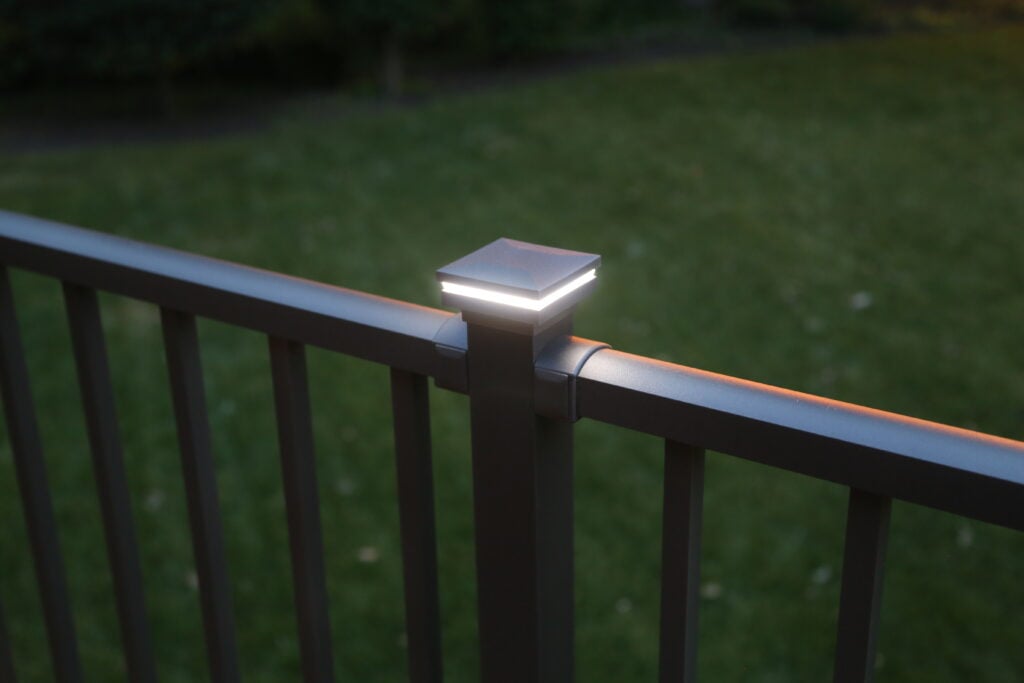
Kadenz railing integrates lighting directly through post cap selection — making it a railing-focused lighting option rather than a full deck-wide lighting system. It’s the right choice when the goal is to finish the railing with intentional, coordinated lighting rather than building out multiple fixture types across the whole deck.
What Kadenz post cap lighting includes:
- Ornamental Post Caps — A decorative finish for homeowners who want a polished railing look without powered lighting at every post.
- Solar Post Cap Lights — Simpler to install, no wiring required. A reasonable decorative option for decks with strong sun exposure. Worth noting: solar performance depends on available sunlight — shade from trees, rooflines, or Minnesota’s shorter winter days can limit output. Best suited to accent or decorative roles, not primary lighting.
- Low-Voltage Post Cap Lights — The stronger choice for dependable, consistent light output. Specific options include the Low Voltage Halo Cap, Low Voltage Combo Cap, and Low Voltage Down Light Cap.
Best for: Homeowners who want railing-focused post cap lighting as part of a clean aluminum railing system — not a full multi-fixture deck lighting plan.
Explore the Kadenz product line → Kadenz railing lighting products

Solar vs. Low-Voltage: What Minnesota Homeowners Should Know
This is one of the most practical questions in any deck lighting conversation, and the answer matters more in Minnesota than it might in other climates.
Solar deck lighting is appealing because it doesn’t require a wiring plan. It works well for decorative post caps and accent lighting. But solar performance depends on sun exposure — and in Minnesota, shade from trees, rooflines, and shorter winter days can limit how well solar lighting charges and holds power through an evening.
Low-voltage deck lighting runs on a transformer and wiring system. It’s more involved to plan and install, but the output is consistent, reliable, and doesn’t depend on how much sun the deck saw that day. For a full integrated lighting plan — stairs, rails, under-rail, accents — low-voltage is almost always the better choice.
Voyager’s take: use solar for decorative convenience, use low-voltage when you need the lights to actually work every night.
How Voyager Helps You Design a Deck Lighting Plan
Deck lighting decisions are easier to make before the deck is built. Wiring, fixture placement, transformer location, and railing coordination all matter — and retrofitting lighting after the fact is always more complicated and often more expensive.
When we work with Minnesota homeowners on a new deck or railing project, we help think through questions like:
- Where do people walk after dark, and which paths need the most visibility?
- Should the lighting feel decorative, functional, or both?
- Is the deck shaded or in full sun? Does solar make sense?
- Which lighting options coordinate with your railing brand and material?
- Is this a quiet evening space, a family gathering deck, or a high-traffic backyard hub?
The goal is never to over-light. A well-planned lighting system should make the deck feel complete — not like a parking lot.
Ready to plan your deck? → Talk to us about your project.
Deciding if Integrated Deck Lighting Is Right for Your Home
Not every deck needs a full lighting system. The right answer depends on how you use your space, what’s already built, and what you want the deck to feel like after dark. These four questions will help you decide.
Is your deck actually getting used after dark? If the answer is rarely — or never — poor visibility is often the reason. Stairs that are hard to see, a space that feels unfinished once the sun drops. The right lighting changes that. If evening use is already part of how your household lives, a planned system will extend it. If it isn’t, lighting might be exactly what creates the habit.
Is your deck new, or already built? Integrating lighting during a new build is almost always cleaner and more cost-effective than retrofitting later. In-deck lights in particular require cutting into the deck surface — straightforward during construction, significantly more involved after the fact. Post cap, riser, and under-rail lights are easier to add later, but the most cohesive results come from planning lighting alongside the deck itself.
What does your budget look like? Deck lighting doesn’t have a single price point. A focused system — stair riser lights and post caps — is a modest addition to most projects. A full layered plan with in-deck lights, under-rail lighting, transformers, and smart controls is a more significant investment. Voyager builds project-specific estimates based on your deck layout, railing system, and goals.
How long will this lighting last? Most LED-based deck lighting from Trex, TimberTech, and Magena Star is rated for tens of thousands of hours of use. In Minnesota’s climate, low-voltage systems outperform solar — freeze-thaw cycles, snow load, and shorter winter days affect solar charging in ways that wired systems simply don’t face. With proper installation, a well-chosen lighting system is a long-term part of your outdoor space.
Make Your Deck Work After Dark
A well-lit deck doesn’t just look better — it works better. Stairs are safer. Evenings stretch longer. Guests are more comfortable. And the outdoor space you invested in becomes a room you actually use instead of one you avoid once the sun drops.
Whether you’re working with Trex, TimberTech, Westbury, or Kadenz, Voyager can help you build a lighting plan that fits your materials, your railing system, and the way you want to spend your Minnesota evenings.
Looking for More Upgrades? Check out these wonderful upgrade ideas for your deck Deck upgrades for Twin Cities homes.